
Planning transportation for a film production in Los Angeles requires more than arranging vehicles. Production teams must coordinate cast pickups, crew transportation, airport transfers, filming locations, parking, and changing schedules while accounting for traffic across the city.
Whether you are organizing a commercial shoot, an independent film, a television production, or a corporate video project, a clear transportation plan can help reduce delays, control costs, and keep the production schedule on track.
The most effective approach is to match each transportation arrangement to the people traveling, the locations involved, and the timing of the production day.
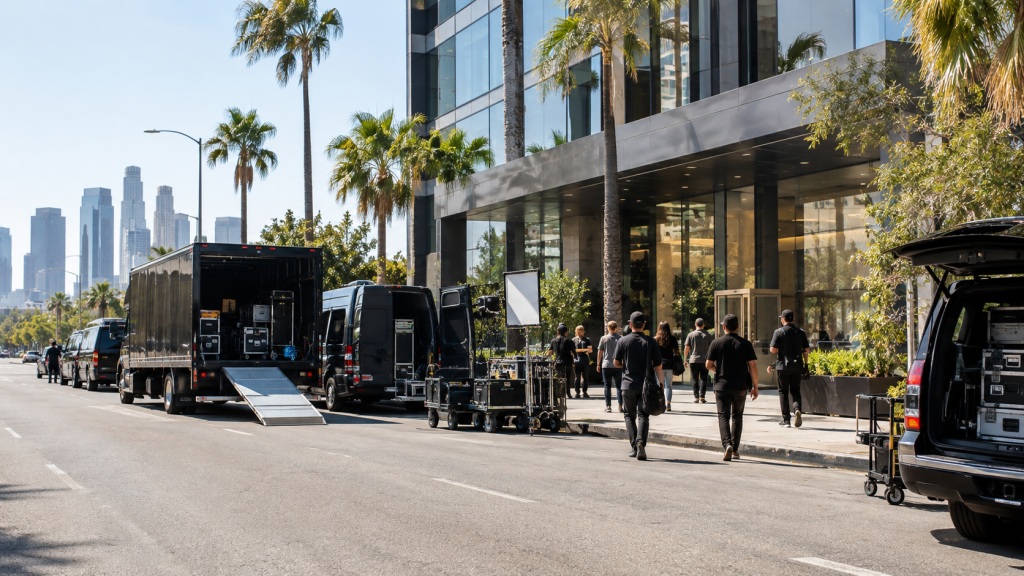
Los Angeles is a major center for film, television, advertising, and commercial production. However, its size and traffic conditions can make transportation between locations difficult to coordinate.
A production might involve a morning pickup in Beverly Hills, a filming location in Hollywood, a meeting in Century City, and an afternoon shoot in Downtown Los Angeles. Although these destinations may appear relatively close on a map, actual travel times can vary considerably depending on traffic, departure time, road conditions, and access to each property.
Transportation planning helps production teams coordinate:
Cast and talent pickups
Crew transportation
Airport transfers for visiting personnel
Travel between filming locations
Producer and executive transportation
Hotel and studio transfers
Parking and vehicle staging
Schedule changes and additional stops
A well-organized transportation plan also helps the production team identify potential problems before filming begins.
The first step is to build a transportation schedule based on the production call sheet and filming itinerary.
List every required movement, including pickup times, passenger names or groups, addresses, destination entrances, and expected arrival times.
For each movement, identify the person responsible for confirming the vehicle and communicating changes.
Your transportation schedule should include:
Pickup date and time
Exact pickup address
Destination address and entrance
Number of passengers
Luggage or personal equipment requirements
Required arrival time
Estimated journey duration
Parking or access instructions
Production contact information
Backup arrangements for delays
Do not rely exclusively on a map’s estimated driving time. A vehicle may reach the correct street but still need additional time to enter a property, find authorized parking, pass security, or reach the actual filming area.
Keep one current version of the itinerary and make sure the production coordinator, transportation provider, and relevant passengers receive updates when changes occur.
Not everyone involved in a film production needs the same type of transportation. Choosing vehicles according to passenger count, schedule, and travel requirements can help avoid unnecessary costs.
A private chauffeur service can be useful for producers, agency executives, visiting clients, and other passengers who need scheduled transportation between meetings, hotels, airports, and filming locations.
For example, an executive visiting Los Angeles might need transportation from LAX to a hotel, followed by meetings in West Hollywood and Century City before returning to the hotel.
An hourly chauffeur arrangement may be worth considering when several stops are planned or the schedule is likely to change. For a single transfer between two locations, a point-to-point booking may be more appropriate.
The best option depends on the itinerary, service duration, waiting requirements, and quoted price.
A luxury SUV may be suitable for small passenger groups, visiting talent, or production personnel traveling with luggage.
Vehicle selection should account for the number of passengers, luggage capacity, comfort requirements, and the amount of space available at pickup and drop-off locations.
Ogun Limo’s listed fleet may include vehicles such as the Cadillac Escalade and Chevrolet Suburban. Confirm the specific vehicle, availability, and passenger capacity when requesting a reservation.
Larger groups may benefit from coordinated group transportation rather than arranging separate rides for every passenger.
Depending on the production requirements and available vehicles, options may include a Mercedes Sprinter or minibus.
Before selecting a vehicle, confirm the passenger count, luggage volume, pickup locations, and whether everyone needs to arrive at the same time.
For large crews, a dedicated shuttle or production-arranged vehicle fleet may be more appropriate than a luxury chauffeur service. The right solution depends on the size and operational needs of the production.
Traffic should be considered a central part of production planning, not an afterthought.
Travel times can change significantly during weekday morning and evening peaks, around major events, and when road conditions are disrupted.
When planning transportation between filming locations, consider the following:
Check traffic conditions for the anticipated departure time.
Allow additional time for parking and property access.
Confirm whether the destination has a designated entrance.
Account for unloading and walking time.
Avoid scheduling consecutive arrivals with no margin for delays.
Recheck routes when the production schedule changes.
For example, a production moving between Santa Monica and Hollywood should not assume that the journey will take the same amount of time throughout the day. The departure time and prevailing traffic conditions can make a substantial difference.
A practical approach is to review the route before the production day and establish a realistic arrival buffer based on the importance of the next call time.
Film productions frequently bring in actors, executives, clients, and crew members from outside Southern California. Airport transportation should be coordinated with the production schedule rather than treated as a separate task.
Los Angeles International Airport is a common arrival point for visitors, but other airports may be more convenient depending on flight availability and the final destination.
Relevant airports include:
Los Angeles International Airport (LAX)
Hollywood Burbank Airport (BUR)
Long Beach Airport (LGB)
John Wayne Airport (SNA)
Consider the traveler’s arrival time, luggage, hotel location, and next production commitment before choosing an airport transfer arrangement.
For each airport pickup, confirm the flight details, passenger contact information, pickup procedure, destination, and the process for communicating delays.
Airport access and pickup procedures can change, so check the airport’s official ground transportation guidance before finalizing arrangements.
For productions coordinating several arrivals, a shared itinerary can help prevent duplicate bookings, missed pickups, and confusion about hotel destinations.
Ogun Limo provides airport transportation services in the Los Angeles area. Production coordinators can review the available options at the Ogun Limo website.
Finding the correct address is only one part of reaching a filming location. Production teams also need to establish where vehicles can legally stop, load passengers, and park.
This is especially important in busy areas such as Hollywood, Downtown Los Angeles, Beverly Hills, and Santa Monica, where curb space and property access may be limited.
Before filming, confirm:
The approved vehicle entrance
Passenger pickup and drop-off points
Available parking arrangements
Loading and unloading restrictions
Security or gate procedures
Whether vehicles need advance access authorization
The location of the nearest practical staging area
Do not assume that a filming permit automatically authorizes every vehicle to park wherever needed. Requirements vary by location and jurisdiction.
For productions in areas covered by FilmLA, review the applicable FilmLA production requirements and confirm parking arrangements with the location manager or permitting authority.
Keep passenger transportation separate from equipment logistics when necessary. A passenger vehicle may be suitable for moving talent or executives but may not meet the needs of a crew transporting cameras, lighting, grip equipment, or other production materials.
The best booking structure depends on how the production day is organized.
Hourly service may be useful when a passenger needs several stops throughout the day, must remain flexible between meetings, or requires the vehicle to stay available for a defined period.
Potential examples include:
Producer meetings at multiple locations
Executive visits to studios and production offices
Transportation between a hotel and several appointments
A schedule with uncertain departure times
Multiple passenger movements within a limited area
When comparing quotes, confirm the included service duration, waiting-time terms, additional-stop charges, and any applicable fees.
A point-to-point transfer may be more suitable when the pickup and destination are known and the passenger does not need the vehicle to remain available afterward.
Examples include:
A hotel-to-studio transfer
An airport pickup followed by a hotel drop-off
A scheduled transfer between two production offices
A single trip to a meeting or filming location
Compare the total quoted cost of each arrangement rather than assuming that hourly service or individual transfers are always cheaper.
For a more detailed comparison, read Hourly Chauffeur vs. One-Way Ride: Which Saves More Money?.
Transportation plans can change during production. A scene may take longer than expected, a location may become unavailable, or a meeting may finish later than planned.
Without a clear communication process, these changes can create confusion among passengers, drivers, and production coordinators.
Establish one primary contact who can approve transportation changes and communicate revised instructions.
A practical communication process should include:
One current transportation itinerary
Confirmed passenger pickup instructions
A designated production contact
A reliable method for communicating changes
Updated destination details when locations change
Confirmation of revised pickup times
A clear process for reporting delays
Avoid sending conflicting instructions through multiple channels. When an itinerary changes, make sure the people directly responsible for the affected movement receive the updated information.
Transportation costs depend on more than the vehicle’s base rate.
The final cost may be affected by service duration, passenger count, number of stops, vehicle requirements, waiting time, parking, additional mileage, and the provider’s booking terms.
When requesting quotes, provide a realistic description of the production schedule.
Include the date, pickup and drop-off addresses, passenger count, number of stops, expected service duration, and any special requirements.
Ask providers to clarify which charges are included and which may be billed separately.
For larger productions, compare the cost of individual transfers with the cost of a coordinated group transportation arrangement. The cheapest option for one passenger may not be the most efficient solution for a group traveling to the same location.
Also consider the operational consequences of delays. A transportation arrangement that saves a small amount but creates scheduling problems may not be the best choice for a time-sensitive production.
Even a detailed itinerary cannot eliminate every production-day disruption.
Build flexibility into the plan, especially when the schedule includes several locations or passengers arriving on different flights.
Useful precautions include:
Confirming the next day’s itinerary in advance
Rechecking flight arrivals before airport pickups
Keeping contact details accessible
Identifying alternative routes where practical
Allowing time for unexpected access delays
Confirming vehicle availability for schedule extensions
Communicating changes as soon as they are approved
If the production frequently changes locations, establish how additional stops or extended service will be handled before the booking is confirmed.
Do not assume that a vehicle can remain available indefinitely or that a booking automatically covers changes to the original itinerary.
Several avoidable mistakes can make a production day more difficult.
A short distance on the map does not necessarily mean a short journey. Consider traffic, property access, parking, and the time required to reach the set.
Confirm the actual passenger count and luggage requirements before selecting a vehicle. A vehicle that accommodates the passengers may not have enough room for all their bags.
Confirm where each vehicle can legally stop, load passengers, and park. Do not assume that every production vehicle is covered by the same arrangements.
Executives, visiting talent, and large crew groups often have different scheduling and vehicle requirements. Plan transportation according to each group’s needs.
A transportation plan is only useful when the people responsible for carrying it out have the latest information.
Review service duration, waiting time, additional stops, mileage, parking, and other applicable charges before comparing providers.
Before the production day, confirm the following:
The current production schedule is available.
Every pickup and destination has an exact address.
Passenger counts and luggage requirements are confirmed.
Vehicles are appropriate for each group.
Airport transfers include the relevant flight details.
Travel buffers account for traffic and property access.
Parking and loading arrangements have been checked.
A primary transportation contact has been assigned.
The process for schedule changes is clear.
Booking terms and possible additional charges are understood.
Drivers and passengers have the correct pickup instructions.
The final itinerary has been shared with the relevant team members.
Completing this checklist can help reduce uncertainty and make transportation easier to manage throughout the shoot.
Start with the production schedule, passenger list, and exact location addresses. Assign suitable vehicles, confirm pickup and drop-off points, allow for traffic and access delays, and establish a process for communicating changes.
Options include production vans, crew shuttles, rental cars, rideshare services, taxis, public transportation, and private chauffeur services. The right mix depends on group size, timing, equipment needs, routes, and budget.
It can be useful for producers, executives, visiting clients, and talent who need scheduled transportation between airports, hotels, meetings, and filming locations. It is not necessarily the most economical option for moving an entire crew.
There is no single buffer that works for every route. Check traffic estimates for the planned departure time and allow additional time for parking, property access, unloading, security, and walking to the set.
Do not assume that production parking arrangements cover every vehicle. Check the applicable rules with FilmLA or the relevant permitting authority and confirm the arrangements with the location team.
The best airport depends on flight availability, the traveler’s final destination, and the ground transportation route. LAX, Hollywood Burbank Airport, Long Beach Airport, and John Wayne Airport may all be relevant for different Southern California itineraries.
Provide the dates, pickup and drop-off addresses, required arrival times, passenger count, luggage needs, number of stops, expected service duration, and a production contact. For airport transfers, include flight details and confirm the pickup procedure.
Use one current itinerary, verify entrances and parking arrangements, build realistic traffic buffers, assign a contact to approve changes, and ensure revised instructions reach everyone responsible for each movement.
Organizing transportation for a film production requires careful coordination between schedules, locations, passengers, and vehicles. By planning movements in advance and preparing for traffic and last-minute changes, production teams can make travel between airports, hotels, meetings, and filming locations easier to manage.
For producers, executives, visiting clients, and other passengers who need private transportation in Los Angeles, Ogun Limo Services offers chauffeur, corporate, airport, and private transportation options.
Visit Ogun Limo to explore available services or request a transportation quote for your upcoming production.
Start with the production schedule, passenger list, and exact location addresses. Then assign vehicles, confirm pickup and drop-off points, allow for traffic and access delays, and establish a process for communicating schedule changes.
Options include production vans, crew shuttles, rental cars, rideshare services, taxis, public transportation, and private chauffeur services. The right mix depends on group size, timing, equipment needs, route, and budget.
It can be useful for producers, executives, visiting clients, and talent who need scheduled transportation between airports, hotels, meetings, and filming locations. It is not necessarily the most economical option for moving an entire crew.
There is no single buffer that works for every route. Check current traffic estimates for the planned departure time and allow additional time for parking, property access, unloading, security, and walking to the set.
Do not assume that production parking arrangements cover every vehicle. Posted parking areas may be restricted to authorized production vehicles, and personal vehicles may be subject to citation. Confirm the applicable rules with the permitting authority and location team.
The best airport depends on available flights, the traveler's final destination, and the ground transportation route. LAX, Hollywood Burbank Airport, Long Beach Airport, and John Wayne Airport may all be relevant for different Southern California itineraries.
Provide the dates, pickup and drop-off addresses, required arrival times, passenger count, luggage needs, number of stops, expected service duration, and a production contact. For airport transfers, include flight details and confirm the pickup procedure.
Use one current itinerary, verify exact entrances and parking arrangements, build realistic traffic buffers, assign a contact to approve changes, and ensure that revised instructions reach the people responsible for each movement.