
Planning college tours in Los Angeles takes more than choosing which campuses to visit. Families also need to account for traffic, campus parking, tour check-in times, walking distances, and the time required to travel between universities.
The most effective approach is to build the itinerary around confirmed campus-tour appointments, group nearby schools together, and leave enough time for traffic and parking. Depending on the number of campuses, group size, and schedule, driving, public transportation, rideshare, or a private chauffeur service may be appropriate.
Los Angeles offers a wide range of college options, from the University of California, Los Angeles (UCLA) in Westwood to the University of Southern California (USC) near Downtown Los Angeles. Other institutions, including Occidental College in Eagle Rock and California State University, Northridge, are in different parts of the metropolitan area. Trying to visit too many campuses in one day can turn an informative trip into a rushed series of transfers.
A well-planned transportation schedule helps students and families spend more time evaluating each school and less time managing the logistics.
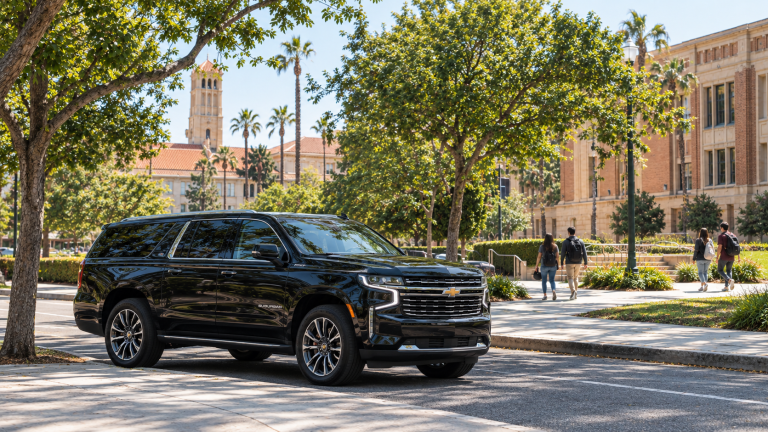
The first step is to group campuses by location. Los Angeles is a large metropolitan area, and two schools that look close on a map may take longer to reach than expected because of freeway congestion, surface-street traffic, or campus access restrictions.
For most families, visiting campuses in the same general area on the same day is more practical than crossing the region repeatedly.
UCLA is located in Westwood, on the west side of Los Angeles. A campus visit can also fit into a broader Westside itinerary if the family has another confirmed appointment nearby.
However, destinations such as Santa Monica, Beverly Hills, and Century City should not automatically be treated as quick stops. Traffic, parking, and the time needed to walk around each destination can add substantially to the day.
Planning tip: Schedule the UCLA tour first or build the rest of the day’s itinerary around its confirmed check-in time. Add another campus only if the transfer and visit durations leave a comfortable margin.
USC’s main campus is in the University Park neighborhood, south of Downtown Los Angeles. Families visiting USC should check the university’s current visitor information for tour meeting points, arrival instructions, and parking options.
A visit to USC may fit with another destination in central Los Angeles, but do not assume that downtown hotels, museums, or other campuses will be easy to reach at every hour. Surface streets, special events, and peak traffic periods can affect travel.
Planning tip: Confirm the exact USC tour meeting point before choosing a drop-off location or parking facility. University entrances and visitor access points may not be interchangeable.
Families considering colleges in northeastern Los Angeles may want to explore Pasadena and Eagle Rock, where institutions such as the California Institute of Technology (Caltech) and Occidental College are located.
These destinations can make sense as a separate part of a Southern California college tour. Whether they can be combined with a Westside or University Park visit depends on the number of appointments and the time available.
Planning tip: Treat Pasadena and Eagle Rock as a distinct geographic cluster when possible. Check the actual route and departure time rather than relying only on straight-line distances.
A wider college search may include California State University, Northridge, or campuses farther from central Los Angeles. These visits can require a different plan from a day focused on UCLA and USC.
If the itinerary extends into Orange County or other parts of Southern California, consider whether an overnight stay would make the trip less rushed. Adding more campuses is not necessarily beneficial if the student has too little time to explore each one.
Transportation should be planned around the universities’ official visit schedules, not the other way around.
Campus-tour availability, registration requirements, check-in points, and visitor instructions vary by institution. Some visits may include an information session followed by a walking tour, while other programs may offer different formats or limited dates.
Before finalizing your route:
Register for each campus tour or information session.
Record the date, start time, check-in deadline, and meeting location.
Check whether the tour includes an information session, a walking tour, or both.
Review official visitor parking and campus-access instructions.
Save confirmation emails and contact information.
Check the university’s current guidance for guests, mobility needs, and any special requirements.
Allow time to park or be dropped off, locate the meeting point, and walk to the check-in area. Arriving at the campus entrance is not necessarily the same as arriving at the tour location.
If a tour begins at 10:00 a.m., for example, do not plan a route that depends on arriving at 9:58 a.m. after a long freeway drive. Build in a buffer for traffic, parking, and finding the correct entrance.
A useful itinerary accounts for more than the time spent on the road. Each visit may involve check-in, a presentation, a walking tour, questions for admissions staff, lunch, and time to explore the surrounding neighborhood.
For a multi-campus day, work backward from the first confirmed appointment and estimate the full duration of every stop.
A planning table makes the logistics easier to evaluate before transportation is booked.
| Planning item | What to include |
|---|---|
| Campus appointment | Confirmed start time and check-in deadline |
| Travel between campuses | Route, departure time, and traffic buffer |
| Arrival logistics | Parking, drop-off point, and walk to check-in |
| Visit duration | Official tour, information session, and questions |
| Meals and breaks | Time to eat, rest, and discuss each campus |
| Schedule flexibility | Extra time for delays or a longer-than-expected visit |
A family visiting UCLA and USC might schedule one campus in the morning and the other in the afternoon, provided the official tour times allow a comfortable transfer between them.
The exact order should depend on the confirmed appointments, traffic forecast, parking arrangements, and the expected duration of each visit. The distance between Westwood and University Park is only one part of the calculation; congestion and campus access can have a greater effect on the schedule.
If both universities offer suitable tour times, compare the total travel and check-in requirements before choosing the order. If the appointments leave little room for delays, visiting one campus per day may be the better decision.
College tours can be tiring, particularly when students spend hours walking outdoors. Leave time for water, meals, restrooms, and conversations about what the student liked or disliked.
A flexible itinerary also gives families room to explore a campus library, student area, or nearby neighborhood when visitor access permits.
The best transportation option depends on how many campuses you plan to visit, where you are staying, the size of your group, and how much schedule flexibility you need.
Driving can be a practical option for families who want independence and are comfortable navigating Los Angeles. It can also make sense when visiting campuses spread across the region.
The main considerations are parking, traffic, navigation, and the responsibility of driving between appointments. Before leaving for each campus, confirm where visitors can park and whether the facility is suitable for the planned length of the visit.
A rental car may be useful when the trip includes destinations beyond Los Angeles, but compare the total rental cost with parking, fuel, and any applicable fees.
Rideshare services can work well for a family traveling between a hotel and one campus or for a day with only a few stops.
For a multi-campus itinerary, consider the time needed to request each ride, vehicle availability, pickup locations, and the possibility of changing traffic conditions. Pickup and drop-off instructions may differ by campus, so confirm the appropriate location before requesting a vehicle.
Rideshare can be convenient when the itinerary is flexible. It may require more coordination when several people are traveling together or when multiple appointments have strict arrival times.
Los Angeles Metro and other regional transit services can be useful for certain campus visits, especially when the route connects conveniently with the hotel and university.
Public transit may reduce the need to park, but travel planning should account for transfers, walking distances, service schedules, and the time needed to reach the exact campus meeting point. A route that reaches a nearby station may still require additional travel on foot or another connection.
Check current route information and service alerts using Metro’s official trip-planning resources. For a multi-campus day, compare the complete door-to-door journey rather than looking only at the rail or bus segment.
A private chauffeur service may be useful when a family has several scheduled visits, wants to travel together, or prefers not to manage parking and navigation between appointments.
With an hourly arrangement, the transportation plan can be organized around the day’s itinerary, subject to the provider’s service terms, availability, and agreed pickup schedule. This can reduce the number of separate ride requests and help families coordinate transfers between campuses.
The trade-off is cost. Private transportation may cost more than public transit or some rideshare trips, particularly for a short itinerary or a small group. Request a quote based on the actual route, service duration, passenger count, and luggage requirements before deciding.
For families who need flexibility between appointments, Ogun Limo’s hourly chauffeur service is one option to consider. Compare the service with other transportation choices based on the itinerary rather than assuming one option is right for every college visit.
Traffic can change the timing of a campus tour, especially when the itinerary crosses multiple parts of the city. Weekday morning and evening commute periods can affect major freeways and surface streets, but delays may also occur outside those windows because of collisions, construction, weather, or special events.
Use a navigation app shortly before departure and review the route again when leaving each campus. A journey that looks manageable the night before may take longer at the actual travel time.
For tours with a fixed start time, aim to arrive in the campus area early enough to handle parking or drop-off, locate the meeting point, and check in without rushing.
The appropriate buffer depends on the route, traffic conditions, parking arrangements, and the university’s instructions. Longer transfers and unfamiliar campuses generally require more flexibility.
Do not assume a university has convenient visitor parking beside the tour meeting point. Some campuses have designated visitor lots or garages, while others provide separate instructions for different events or appointments.
Check each institution’s official visitor-parking page before the trip. Confirm the location, payment arrangements, any time limits, and whether a reservation or permit is required.
If using a chauffeur or rideshare service, verify the permitted pickup and drop-off area. A nearby gate or street entrance may not be the official meeting point.
Major sporting events, concerts, conventions, and university activities can affect traffic and parking in Los Angeles. If a campus visit coincides with a large event near the route, adjust departure times or consider a different order for the day’s stops.
Do not rely on a general estimate of travel time for a day with several fixed appointments. Recheck conditions before each transfer.
The right vehicle depends on the number of travelers, luggage, mobility needs, and the distance between stops. A family of two or three may have different requirements from a group of relatives or a school counselor traveling with several students.
Consider the following when comparing transportation:
Passenger capacity: Confirm the actual seating capacity of the vehicle offered.
Luggage: Account for suitcases, backpacks, and any items being carried between hotels and campuses.
Comfort: Consider the total time spent in the vehicle, particularly on a multi-campus day.
Accessibility: Discuss mobility requirements in advance and confirm that the proposed vehicle and pickup arrangements can accommodate them.
Pickup coordination: Make sure every passenger knows where and when to meet the driver.
Schedule changes: Ask how additional stops, delays, or changes to the itinerary affect the arrangement.
Do not choose a vehicle based on its name or appearance alone. Confirm the specific vehicle, available seating, luggage capacity, and any accessibility features directly with the provider.
For a private transportation arrangement, share the full itinerary and passenger count before requesting a quote. This helps the provider assess the actual requirements instead of pricing an incomplete route.
Families flying to Southern California may need transportation from an airport to their hotel before starting campus visits. The most suitable airport depends on flight availability, the hotel location, and the campuses on the itinerary.
Los Angeles International Airport (LAX) is a major gateway for Los Angeles, but Hollywood Burbank Airport (BUR), Long Beach Airport (LGB), and John Wayne Airport (SNA) may also be relevant depending on the trip. These airports are in different parts of the region, so choosing an airport solely because a flight is available can affect the overall ground-transportation plan.
Before booking:
Compare flight options with the location of the first campus and the hotel.
Check the airport’s current ground-transportation instructions.
Allow time for baggage claim, airport pickup, and traffic.
Avoid scheduling a campus tour too soon after a flight that may be delayed.
Consider whether a hotel closer to the first campus would simplify the following morning.
For airport-specific ground-transportation information, consult the official LAX transportation and traffic page when arriving at LAX. For other airports, review their own official websites for current pickup rules and transportation options.
If the family plans to visit several campuses after landing, arrange the airport transfer and campus-tour transportation as connected parts of the itinerary rather than treating them as unrelated trips.
Transportation planning should support the purpose of the visit: helping the student determine whether a college is a good fit.
Avoid filling the itinerary with so many campuses that there is no time to reflect on each one. After a tour, leave a short break for the student and family to record impressions, discuss questions, and identify anything they want to research later.
A simple note-taking checklist can include:
What did the student like most about the campus?
Did the academic environment match their interests?
How did the surrounding neighborhood feel?
What questions remain about housing, student life, or academic programs?
Would the student want to return for a more detailed visit?
If the itinerary includes a long drive between campuses, use that time to discuss the previous visit rather than rushing straight into the next appointment. The goal is not simply to see more universities; it is to gather useful information for an informed decision.
A few planning mistakes can make a campus-visit trip more stressful than necessary.
Trying to visit too many campuses in one day. Every additional stop creates more travel, check-in, and scheduling requirements. Prioritize the schools that matter most.
Using straight-line distance to estimate travel time. Los Angeles routes are affected by freeway access, congestion, and local streets. Estimate the actual journey at the expected departure time.
Ignoring the official check-in location. A campus address may not identify the correct tour meeting point. Read the confirmation email and visitor instructions.
Assuming parking will be available at the entrance. Verify visitor parking or the permitted drop-off point before the day of the visit.
Leaving no time for meals or delays. Build breaks into the itinerary and keep some flexibility between appointments.
Booking transportation without sharing the full plan. For a multi-stop service, provide every destination, the required arrival times, passenger count, luggage needs, and any mobility considerations.
Treating every campus as a short stop. Some visits include several components and require substantial walking. Check the official program details before estimating the time needed.
Private transportation is worth considering when the itinerary includes several scheduled campus visits, the group needs to stay together, or the family prefers to avoid driving and parking at each destination.
It may be less necessary for a single campus visit near the hotel, a flexible trip using convenient public transit, or a family that is comfortable driving and navigating the region.
Compare the total cost and convenience of each option. For a private service, request a quote that reflects the complete itinerary, including the number of hours, stops, passenger count, and any airport transfers. Confirm what is included and how additional time or itinerary changes are handled.
Ogun Limo provides transportation services in the Los Angeles area, including hourly chauffeur service and corporate transportation. Although corporate transportation is designed for business-related needs, the hourly service may be relevant to families seeking a planned, multi-stop day. Ask the company whether your specific college-tour itinerary can be accommodated.
The best way to plan transportation for college tours in Los Angeles is to begin with confirmed campus appointments, group nearby universities together, and build a realistic schedule around traffic, parking, check-in requirements, and breaks.
Driving, rideshare, public transit, and private chauffeur services can all be suitable under different circumstances. The right choice depends on the itinerary, group size, budget, and how much flexibility the family needs.
If you are organizing a multi-campus visit and would like to explore a private transportation option, visit Ogun Limo or review the hourly chauffeur service. Share your planned campuses, dates, passenger count, and timing requirements to ask whether the service fits your trip.
The best option depends on the campuses, schedule, group size, and budget. Driving offers flexibility, public transportation can work for well-connected routes, rideshare suits individual transfers, and an hourly chauffeur service may be useful for a multi-campus itinerary with fixed appointments.
There is no universal number because tour durations, traffic, and campus locations vary. For a useful visit, prioritize a manageable number of nearby campuses and confirm that the official tour schedules leave enough time for travel, parking, check-in, meals, and delays.
Yes. Register for the campus tours first, then plan transportation around the confirmed appointment times and meeting locations. This reduces the risk of booking a route that cannot accommodate the universities' schedules.
Parking rules differ by campus. Some universities require visitor permits or paid parking, and the closest parking facility may not be next to the tour meeting point. Check each university's official visitor-parking instructions before traveling.
A private chauffeur may be worth considering when a family has several scheduled visits, wants to travel together, or prefers not to drive and park at every campus. For a single visit or a convenient public-transit route, another option may be more economical.
The most suitable airport depends on flight availability, hotel location, and the campuses on your itinerary. LAX, Hollywood Burbank Airport, Long Beach Airport, and John Wayne Airport serve different parts of Southern California, so compare the full ground journey before choosing flights.
Allow enough time for the expected journey, traffic, parking or drop-off, and walking to the next check-in point. Use current route estimates and add a buffer, especially when crossing Los Angeles or traveling during busy periods.
An hourly chauffeur arrangement may suit a multi-stop day, subject to the provider's availability, service terms, vehicle capacity, and agreed schedule. Share all campuses, appointment times, passenger numbers, and any airport transfers when requesting a quote.